2020. május 14., csütörtök

2JP2 100 (14)

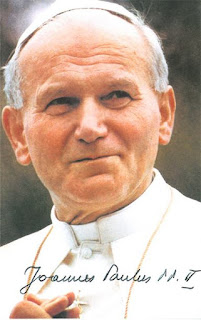
Pope Saint John Paul II. the Great
(Saint Karol Józef  Wojtyła)
/1920-2005/
Photo credit:

(PL) „Ludzkosc dysponuje dzis nieslychanie skutecznymi srodkami,którymi moze zamienic swiat w kwitnacy ogród albo obrócic go w ruine.”

(HU) „Az emberiség ma hallatlanul eredményes eszközökkel rendelkezik, amelyekkel virágzó kertté változtathatja a világot, vagy romba is döntheti azt.”

(EN) “Humanity now has instruments of unprecedented power: we can turn this world into a garden,
or reduce it to a pile of rubble.

(IT) „L'umanità possiede oggi strumenti d’inaudita potenza:può fare di questo mondo un giardino, o ridurlo a un ammasso di macerie.”

(DE) „Die Menschheit besitzt heute nie dagewesene Mittel zur Macht: Sie ist imstande, diese Welt zu einem blühenden Garten zu machen oder sie völlig zu zerstören.”

(FR) „Aujourd’hui, l’humanité possède des moyens de puissance inouïe:elle peut faire de ce monde un jardin, ou le réduire à un amas de cendres.”

(ES) „La humanidad posee hoy instrumentos de potencia inaudita.Puede hacer de este mundo un jardín o reducirlo a un cúmulo de escombros.”

(PT) „A humanidade possui, hoje, instrumentos de força inaudita:pode fazer deste mundo um jardim, ou reduzi-lo a um amontoado de ruínas.”

(08. 10. 2000. 10. 08.)

2020. május 13., szerda

2JP2 100 (13)

Pope Saint John Paul II. the Great
(Saint Karol Józef  Wojtyła)
/1920-2005/
Photo credit:

(HU) „A háború az emberiség veresége. Csak békében és a béke által lehet az emberi méltóság és a hozzáfűződő elidegeníthetetlen jogokat iránti tiszteletet garantálni.”

(EN) “War is a defeat for humanity. Only in peace and through peace can respect for human dignity and its inalienable rights be guaranteed.”

(IT) „Con la guerra, è l'umanità a perdere. Solo nella pace e con la pace si può garantire il rispetto della dignità della persona umana e dei suoi inalienabili diritti.”

(DE) „Mit dem Krieg bleibt die Menschlichkeit als Verlierer zurück. Nur im Frieden und durch den Frieden ist die Achtung vor der Würde der menschlichen Person und ihrer unveräußerlichen Rechte zu gewährleisten.”

(FR) „Avec la guerre, c'est l'humanité qui perd. Ce n'est que dans la paix et avec la paix que l'on peut garantir le respect de la dignité de la personne humaine et de ses droits inaliénables.”

(ES) „Con la guerra, la humanidad es la que pierde. Sólo desde la paz y con la paz se puede garantizar el respeto de la dignidad de la persona humana y de sus derechos inalienables.

(PT) „Com a guerra, quem perde é a humanidade. Só na paz e com a paz é que se pode garantir o respeito da dignidade da pessoa humana e dos seus direitos inalienáveis.”

(RO) „Prin război cea care pierde este omenirea. Numai prin pace și cu pacea se poate garanta respectarea demnității persoanei umane și a drepturilor sale inalienabile.”

(01. 01. 2000. 01. 01.)

2020. május 12., kedd

2JP2 100 (12)

Pope Saint John Paul II. the Great
(Saint Karol Józef  Wojtyła)
/1920-2005/
Photo credit:

(HU) „A betegség ‒ mely a mindennapok tapasztalatában a természetes életerő frusztrációjaként fogható fel ‒ a hívők számára felhívássá válik, hogy az új, nehéz helyzetet a hitnek megfelelő szemszögből »olvassuk«.”

(EN) “Illness, which in everyday experience is perceived as a frustration of the natural life force, for believers becomes an appeal to »read« the new, difficult situation in the perspective which is proper to faith.”

(IT) „La malattia, che nell'esperienza quotidiana è percepita come una frustrazione della naturale forza vitale, diventa per i credenti un appello a »leggere« la nuova difficile situazione nell'ottica che è propria della fede.”

(FR) „La maladie, perçue au long d'une expérience quotidienne comme une frustration de la force vitale naturelle, devient pour les croyants un appel à »lire« cette situation nouvelle et douloureuse dans une optique qui est propre à la foi.”

(ES) „La enfermedad, que en la experiencia diaria se percibe como una frustración de la fuerza vital natural, se convierte para los creyentes en una invitación a »leer« la nueva y difícil situación, en la perspectiva propia de la fe.”

(21. 10. 1992)

2020. május 11., hétfő

2JP2 100 (11)

Pope Saint John Paul II. the Great
(Saint Karol Józef  Wojtyła)
/1920-2005/
Photo credit:

(HU) „Azzal az igénnyel föllépni, hogy amit igaznak tartok, azt másokra is rá kell kényszeríteni, a személy méltóságának megsértése, s valójában bűn Isten ellen, akinek képmása a másik ember. Ezért a fundamentalista fanatizmus az istenhittel alapjában ellenkező magatartás. Ha jól megnézzük, a terrorizmus nemcsak az embert aljasítja eszközzé, hanem Istent is, egészen addig, hogy a saját céljai szolgálatára bálványt csinál Belőle.”

(EN) “To try to impose on others by violent means what we consider to be the truth is an offence against human dignity, and ultimately an offence against God whose image that person bears. For this reason, what is usually referred to as fundamentalism is an attitude radically opposed to belief in God. Terrorism exploits not just people, it exploits God: it ends by making him an idol to be used for one's own purposes.”

(IT) „Pretendere di imporre ad altri con la violenza quella che si ritiene essere la verità, significa violare la dignità dell'essere umano e, in definitiva, fare oltraggio a Dio, di cui egli è immagine. Per questo il fanatismo fondamentalista è un atteggiamento radicalmente contrario alla fede in Dio. A ben guardare il terrorismo strumentalizza non solo l'uomo, ma anche Dio, finendo per farne un idolo di cui si serve per i propri scopi.”

(DE) „Die Anmaßung, das, was man selbst für die Wahrheit hält, anderen gewaltsam aufzuzwingen, bedeutet, daß dadurch die Würde des Menschen verletzt und schließlich Gott, dessen Abbild er ist, beleidigt wird. Darum ist der fundamentalistische Fanatismus eine Haltung, die in radikalem Gegensatz zum Glauben an Gott steht. Wenn wir genau hinschauen, instrumentalisiert der Terrorismus nicht nur den Menschen, sondern auch Gott, indem er ihn schließlich zu einem Götzen macht, dessen er sich für seine Zwecke bedient.”

(FR) „Prétendre imposer à d'autres par la violence ce que l'on considère comme la vérité signifie violer la dignité de l'être humain et, en définitive, outrager Dieu dont il est l'image. C'est pourquoi le fanatisme fondamentaliste est une attitude radicalement contraire à la foi en Dieu. À y regarder de près, le terrorisme exploite non seulement l'homme, mais Dieu lui-même, dont il finit par faire une idole qu'il utilise à ses propres fins.”

(ES) „Pretender imponer a otros con la violencia lo que se considera como la verdad, significa violar la dignidad del ser humano y, en definitiva, ultrajar a Dios, del cual es imagen. Por eso, el fanatismo fundamentalista es una actitud radicalmente contraria a la fe en Dios. Si nos fijamos bien, el terrorismo no sólo instrumentaliza al hombre, sino también a Dios, haciendo de él un ídolo, del cual se sirve para sus propios objetivos.”

(RO) „A încerca să impunem celorlalți prin mijloace violente ceea ce noi considerăm a fi adevărat înseamnă o ofensă adusă demnității ființei umane și, în final, o ofensă adusă lui Dumnezeu, a cărui imagine o poartă în el fiecare om. Fundamentalismul fanatic este de aceea o atitudine radical opusă credinței în Dumnezeu. Terorismul exploatează nu numai oamenii, ci și pe Dumnezeu, terminând prin a-L transforma într-un idol folosit în scopuri proprii.”

(PT) „Pretender impôr aos outros com violência aquela que se presume ser a verdade, significa violar a dignidade do ser humano e, em última instância, ultrajar a Deus, de quem aquele ele é imagem. Por isso, o fanatismo fundamentalista é um comportamento radicalmente contrário à fé em Deus. Visto de outro modo, o terrorismo instrumentaliza não somente o homem, mas também Deus, acabando por fazer d'Ele um ídolo de que se serve para os seus próprios fins.”

(ZH) „以暴力的方式强迫他人接受自己所认为的真理,是违反人性的尊严,到最 后也侵犯了我们所佩带的肖像--天主。因此我们以为基本教义派是一种激烈地反 对信仰天主的态度。恐怖主义不只是在利用人,也利用天主;把天主塑造成一个 偶像,藉以达到自己的目的。”

(01. 01. 2002. 01. 01.)

2020. május 10., vasárnap

2JP2 100 (10)

Pope Saint John Paul II. the Great
(Saint Karol Józef  Wojtyła)
/1920-2005/
Photo credit:

(HU) „A leggyengébbet örömmel fogadni, segíteni őt útján: a civilizáltság jele.

(EN) “To welcome the weakest, helping them on their journey, is a sign of civilization.”

(IT) „Accogliere i più deboli, aiutandoli nel loro cammino, è segno di civiltà.”

(DE) „Die Schwächeren aufnehmen und ihnen auf ihrem Weg zu helfen ist ein Zeichen von Zivilisation.”

(ES) „Acoger a los más débiles, ayudándoles en su camino, es signo de civilización.”

(PT) „Acolher os mais débeis, ajudando-os no seu caminho, é sinal de civilização.”

(Részlet a Szentatya A fogyatékos gyermekek integrációja témájú kongresszus résztvevőihez című beszédből /Fragment from the Address of the Holy Father to the Congress on integration of Disabled Children/Discorso del Santo Padre al congresso sull'integrazione dei bambini disabili/Bruchstück von der Rede des Heiligen Vaters zum Kongress zur Integration der behinderten Kinder/Fragmento de Congreso sobre integración de niños discapacitados/Fragmento do discurso do Santo Padre ao Congresso sobre integração de crianças deficientes, 04. 12. 1999. 12. 04.)

2020. május 9., szombat

2JP2 100 (9)

 Pope Saint John Paul II. the Great
(Saint Karol Józef  Wojtyła)
/1920-2005/
Photo credit:

(HU) „Elszomorító tudni, hogy a mai világban az az egyszerű tény, hogy valaki nő, és nem férfi, csökkentheti annak valószínűségét, hogy világra jöjjön, és hogy megérje a felnőttkort. Jelenthet kevésbé kielegítő mennyiségű táplálékot és rosszabb egészségügyi ellátást, növelheti az esélyt, hogy írástudatlan marad, és csak nagyon korlátozott mértékben vagy egyáltalán nem fér hozzá az alapfokú oktatáshoz [...] Az Egyház minden férfitagjához fordulok, hogy ha kell, változzanak meg szívükben, és alakítsanak ki pozitív képet magukban a nőkről, ahogyan azt hitük követeli.”

(EN) It is disheartening to note that in today’s world, the simple fact of being a female, rather than a male, can reduce the likelihood of being born or of surviving childhood; it can mean receiving less adequate nutrition and health care, and it can increase the chance of remaining illiterate and having only limited access, or none at all, even to primary education. [...] I appeal to all men in the Church to undergo, where necessary, a change of heart and to implement, as a demand of their faith, a positive vision of women.”

(IT) „È scoraggiante osservare come nel mondo di oggi, il semplice fatto di essere donna, piuttosto che uomo, possa ridurre la probabilità di nascere o di poter sopravvivere; può significare ricevere nutrizione e cure sanitarie meno adeguate e può aumentare la possibilità di restare analfabeti e di avere un accesso soltanto limitato, o perfino nullo, all’istruzione primaria. [...] Esorto tutti gli uomini nella Chiesa a realizzare, dove necessario, un mutamento del cuore e a fare propria, come esigenza di fede, una visione positiva delle donne.”

(ES) „Es desalentador notar que en el mundo actual, el simple hecho de ser mujer, más bien que varón puede reducir las probabilidades de nacer o de sobrevivir en la infancia; puede significar recibir una alimentación y una asistencia sanitaria menos adecuadas, y aumentar las posibilidades de ser analfabetas o tener sólo un acceso limitado, o ni siquiera tener acceso, a la educación primaria. [...] Exhorto a todos los hombres en la Iglesia a realizar, donde sea necesario, un cambio de corazón, y a tener, como exigencia de su fe, una visión positiva de la mujer.”

(Részlet a Nők IV. világkonferenciáján mondott beszédből/Excerpt from the speech held at the 4th Wolrd Conference on Women/Frammento del discorso della IV. conferenza mondiale sulla donna/Fragmento del discurso a la IV conferencia mundial sobre la mujer, 29. 08. 1995. 08. 29.)

2020. május 8., péntek

2JP2 100 (8)

Fényképezte/Photo credit: Csomafáy Ferenc
 Pope Saint John Paul II. the Great
(Saint Karol Józef  Wojtyła)
/1920-2005/
Photo credit:

(HU) II. János Pál Márton Áron erdélyi püspökről: „az Úr feddhetetlen szolgája, aki nem futamodott meg sem a munkától, sem a szenvedéstől

(LAT) Iohannes Paulus II de Áron Márton, episcopus transilvaninensis: „Integerrimus Domini famulus nullis parcens laboribus nullisque doloribus

(RO) Ioan Paul al II-lea despre episcopul transilvan Áron Márton: „cel mai integru slujitor al Domnului, care nu ţi-ai cruţat nici munca și nici suferinţele.

(02. 04. 1980. 04. 02)

Forrás/Sursă:

Márta Bodó - Gergely Kovács - Csilla Lázár (red.): Márton Áron - Un episcop catolic pe calea crucii.[https://verbumkiado.ro/hu/konyv/marton-aron-un-episcop-catolic-pe-calea-crucii] (06. 05. 2020.)